


- 0-5-10-15-20 — chanted as "shíwǔ, shíwǔ" (十五十五) — is a two-player hand game in which each closed fist counts as 0 and each open hand counts as 5.
- On your turn you show your hands and simultaneously call the combined total of both players' hands: 0, 5, 10, 15, or 20.
- Guess correctly twice in a row and you win the round. Call a total that your own hands make mathematically impossible and you lose it.
- It is a fast, low-stakes way to drill Chinese numbers in real time, which is why it shows up at CLI dinners, dorm rooms, and banquet tables alike.
"Five," she yells as her right hand opens, left hand closes, and I close both of mine. Ugh, she's got me again.
"No worries," I think to myself. "I know what she'll do next; whenever her right hand is open, her next move is always to open her left hand and call 'ten.' I'll play this next round safe and open both hands."
Here it comes… "WHAT?" She kept her hands exactly where they were and called "fifteen!"
That's two correct calls in a row, so she wins.
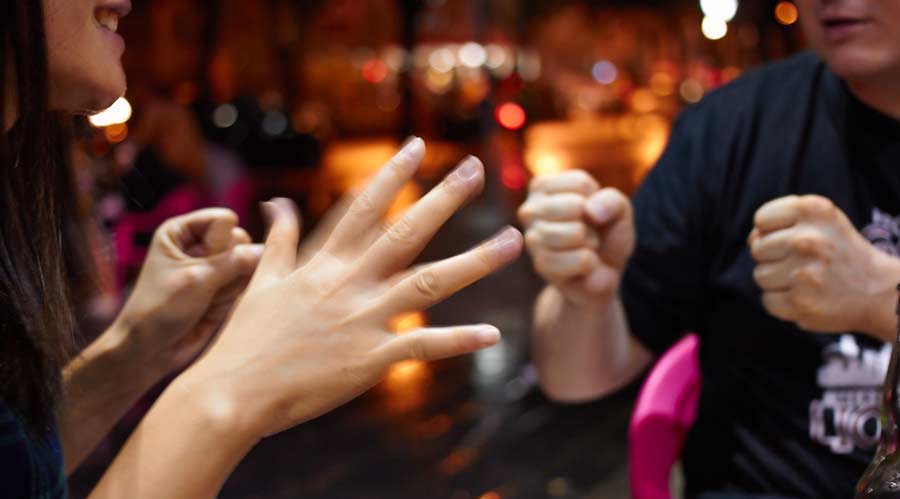
0-5-10-15-20 (or shíwǔ, shíwǔ) is a great Chinese game that can be used to decide anything from who chooses tonight's restaurant or sits in the best seat to who pays for this round of drinks or needs to take a drink now.
It takes about thirty seconds to learn and years to stop losing at. Below is everything you need to play your first round tonight.
01 What Is 0-5-10-15-20?
The game has no single official name in Chinese. Most people simply call it by the numbers, or by the rhythm they chant while playing it: "shíwǔ, shíwǔ" (十五十五).
It belongs to a much older family of Chinese guessing games known collectively as jiǔlìng (酒令), the drinking games played at Chinese banquets for centuries. Its closest cousin is huáquán (划拳), the loud finger-guessing contest you will hear at almost any Chinese restaurant with a lively table.
What makes 0-5-10-15-20 different is its simplicity. There are only three things your hands can do, and only five numbers you can ever call.
That constraint is exactly why it works so well for learners. You end up saying basic Chinese words — five numbers, over and over — at conversational speed, under mild pressure, with instant feedback.
02 How to Play, Step by Step
The two opponents sit or stand face-to-face. Put up your dukes and get ready — don't worry, no one will be hit.
- Decide who goes first. That person is Player 1 for the first turn.
- At any moment, Player 1 makes a hand motion and simultaneously calls out a number. Player 2 makes a hand motion at the same instant but says nothing.
- Each player has four options: keep both hands closed, open the left hand only, open the right hand only, or open both hands. A closed fist is 0 and an open hand is 5.
- The number Player 1 calls is a guess at the sum of both players' hands: 0 (零, líng), 5 (五, wǔ), 10 (十, shí), 15 (十五, shíwǔ), or 20 (二十, èrshí).
- If the guess is correct, Player 1 is halfway to a victory. To actually win, she has to guess correctly twice in a row.
- If the guess is wrong, it is immediately Player 2's turn to call.
- Either way, both players leave their hands exactly where they are between rounds. Your hands only change when it is your turn to move.
Player 1 opens only her left hand and calls "5." Player 2 has both hands open, so the real total is 15 and the call is wrong.
It is now Player 2's turn. Player 1's left hand stays open and her right hand stays closed; both of Player 2's hands stay open until he makes his next move.
There is no limit on how long or short the pause between calls must be. A player can call "0" while both players show 0, then immediately call "5" and open a hand, hoping the opponent's fists stay closed.
Just remember that the two correct calls have to be consecutive. If the first "0" was wrong, the second call doesn't count, because the turn has already passed to the other player.
03 Legal Calls and Impossible Calls
Calling any mathematical impossibility counts as a single loss for that player. Because you can see your own hands, you always know which totals are still on the table.
Saying "0" while showing 5 or 10 is an automatic loss, and so is saying "5" while showing 10. Saying "10" while showing 0 is perfectly acceptable, because your opponent could be showing 10.
| Your hands | Your value | Totals you may legally call |
|---|---|---|
| Both fists closed | 0 | 0, 5, 10 |
| One hand open | 5 | 5, 10, 15 |
| Both hands open | 10 | 10, 15, 20 |
The pattern is easy to hold in your head: you may call your own value, your value plus 5, or your value plus 10. Anything outside that window is an instant loss.
This is also why the totals only ever land on multiples of five. Since hands come in units of 0 and 5, odd numbers simply cannot happen.
04 Variations
The Rhythm Version
Some people play with a rhythm, chanting "shíwǔ, shíwǔ, 0/5/10/15/20!" and then pausing before the next call. Only the final number counts as the guess.
So when it is Player 1's turn, she might say "shíwǔ, shíwǔ, wǔ!" — meaning her guess for that round was 5 (五, wǔ). Or she could say "shíwǔ, shíwǔ, líng!", meaning her guess was 0 (零, líng), in which case both of her hands would have to stay closed and she would be hoping Player 2's hands stayed closed too.
Group Play
At a full table, the game usually runs as a knockout: winners stay on, losers pass the turn or take the penalty. The loser of each round drinks, which is where the game earns its reputation as a 罚酒 (fájiǔ, "penalty drink") staple.
It works just as well without alcohol. Play for who does the washing up, who picks the film, or who buys the milk tea.
House Rules
Agree on the details before you start, because they vary from table to table. Some groups require three correct calls in a row instead of two, and some let an impossible call simply pass the turn rather than end the round.
Other tables ban repeating the same call twice in a row to stop players from camping on one number. None of these is more "correct" than the others — the version your friends play is the right one.
05 How to Win More Rounds
The game looks like luck and plays like poker. Your hands are public information, so every call you make tells your opponent something about how you think.
Watch for Patterns
Most players fall into loops without noticing — open, open, closed, repeat. Track two or three of your opponent's turns and the loop usually shows itself.
Then break your own. If you have called "10" twice, the safest thing you can do next is call something else entirely.
Use the Safe Calls
Calling your own value plus 5 is the statistically comfortable choice, since your opponent has to show 5 for you to be right. Calling 0 or 20 is the gamble, because it requires your opponent to be at an extreme.
That said, extremes are exactly what nobody expects. A well-timed "20" wins rounds precisely because it looks reckless.
Train Your Ear
The hardest part for most learners isn't the maths — it's hearing shí and shíwǔ correctly when someone shouts them at speed. If that trips you up, our guide to improving your Chinese listening comprehension is a good place to start.
It also helps to be solid on pinyin and tones before you play. Mixing up shí (十, ten) and shì (是, to be) in a quiet classroom is one thing; doing it across a noisy dinner table is another.
For learners who want to take their Chinese further, structured one-on-one instruction turns games like this from guesswork into genuine practice.

Study Chinese in Guilin or Start Online
CLI offers personalized Chinese instruction built around your goals. Join our Immersion Program in Guilin or begin from anywhere with a free Chinese lesson .
06 Playing It at a Chinese Table
Hand games are social glue in China, and knowing one gives you an easy way into a group. They sit alongside older pastimes like Chinese chess as part of the everyday culture of playing together.
If the game comes out at a meal, a little context helps. Our guide to Chinese table manners covers who pours, who toasts first, and how to decline a drink politely.
You can always play for something other than alcohol, and nobody will think it strange. Swapping the penalty drink for tea or juice is common and keeps the game friendly for everyone at the table.
There is no better place to practise than in the middle of it all. Students who learn Chinese in China tend to pick up games like this in their first week, usually by losing badly to a homestay family.
07 Useful Vocabulary
These are the words you will actually hear while the game is running. Learn the first five and you can play tonight.
| Chinese | Pinyin | Translation |
|---|---|---|
| 零 | zero | |
| 五 | five | |
| 十 | ten | |
| 十五 | fifteen | |
| 二十 | twenty | |
| 猜 | to guess | |
| 拳 | fist | |
| 猜拳 | to play a hand-guessing game | |
| 划拳 | finger-guessing drinking game | |
| 酒令 | drinking game | |
| 手 | hand | |
| 左手 | left hand | |
| 右手 | right hand | |
| 张开 | to open, to spread | |
| 握拳 | to make a fist | |
| 加 | to add | |
| 一共 | altogether, in total | |
| 赢 | to win | |
| 输 | to lose | |
| 到你了 | it's your turn | |
| 再来一次 | one more time | |
| 干杯 | cheers, bottoms up | |
| 罚酒 | penalty drink | |
| 石头剪刀布 | rock paper scissors |
08 Your Turn!
Now that you know how to play, be careful not to fall into predictable patterns, and don't let your opponent know if you know what he or she is thinking. Good luck out there!
Ready for the next level? If you really want to test your Chinese number guessing skills, check out Caima (猜码), a faster finger-guessing game that runs all the way from 0 to 10.
And if you want to learn more about the hidden meanings behind Chinese numbers, check out this article on Chinese numerology. It explains why 8 gets a wedding date and 4 gets skipped in the lift.